Predicting how an earthquake rupture propagates is one of the classic problems in Computational Geophysics. It involves complex physics, uncertain fault parameters, and computationally expensive dynamic simulations.
In my research, "Application of machine learning techniques to predict rupture propagation and arrest in 2-D dynamic earthquake simulations," I explored how we can use Machine Learning to shortcut these expensive simulations without losing accuracy.
The Problem: Computational Cost
Physics-based dynamic rupture simulations are the gold standard. They solve the elastodynamic equations coupled with friction laws. However, they face two major hurdles:
- Uncertainty: We often don't know the exact stress conditions or frictional properties of a fault deep underground.
- Cost: Running thousands of simulations to explore these unknown parameters is computationally prohibitive.
The Physics: Friction and Stress
The simulations are governed by the Linear Slip-Weakening Law, which describes how the fault strength evolves during a rupture.
Where:
- : Peak static strength ()
- : Dynamic sliding strength
- : Critical slip distance
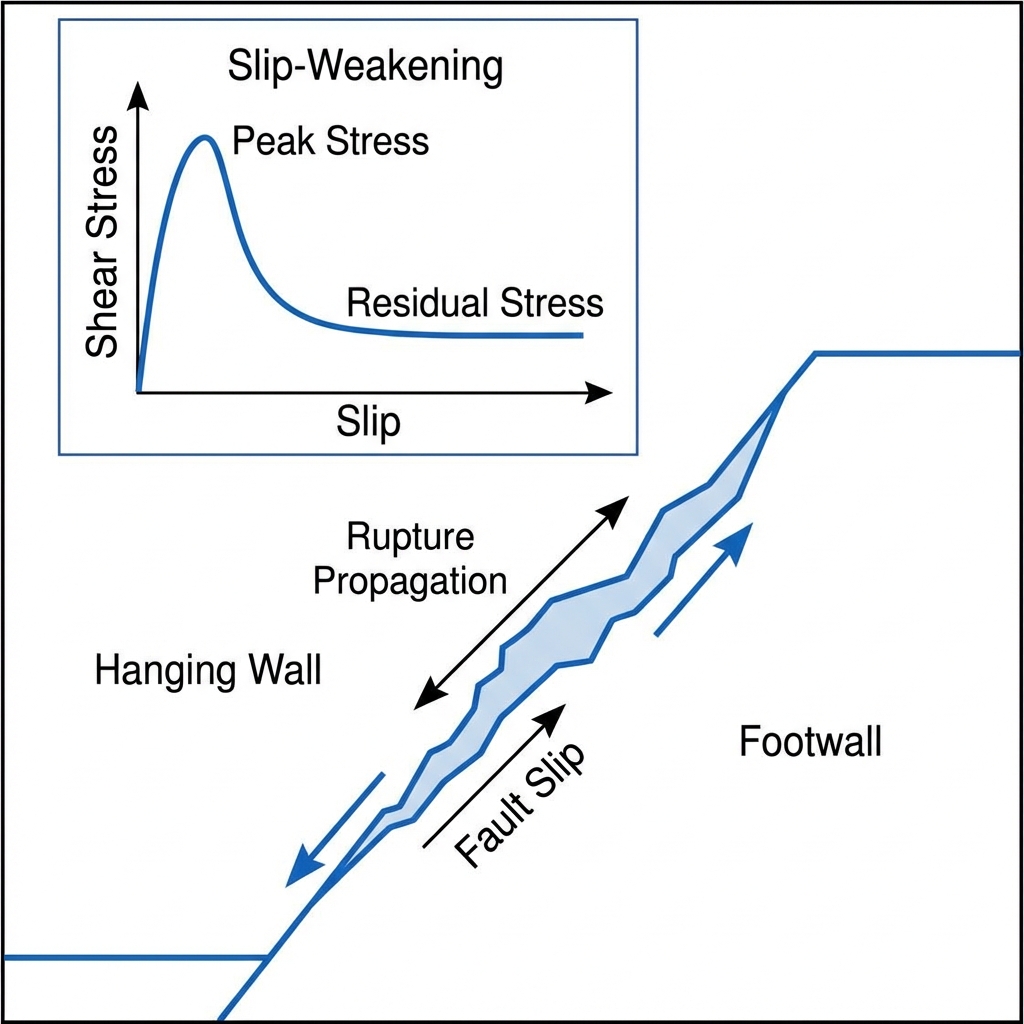
A key metric we use to characterize the fault's readiness to rupture is the S-ratio:
- Low () implies the fault is critically stressed and prone to supershear rupture.
- High implies a large energy barrier to nucleation.
The Solution: ML as a Surrogate
Instead of running the physics solver every time, could we train an ML model to predict the outcome of a simulation?
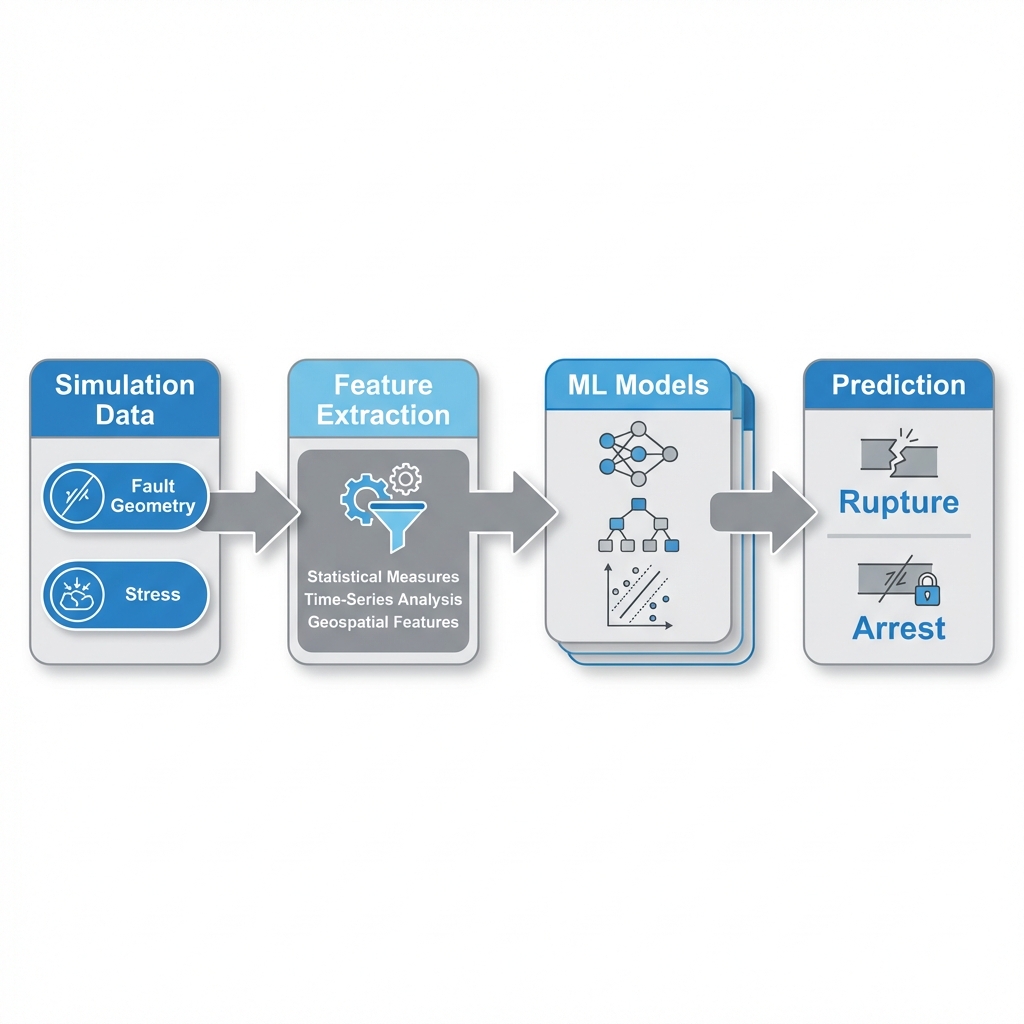
We built a dataset of 1,600 dynamic rupture simulations. In each simulation, we varied:
- Fault geometry (roughness)
- Stress conditions (normal and shear stress)
- Frictional parameters (static and dynamic friction coefficients)
The Models
We trained two types of models to classify whether a rupture would propagate through a geometric barrier or arrest (stop):
- Artificial Neural Network (ANN): Capable of capturing non-linear relationships between stress and friction.
- Random Forest (RF): Excellent for explainability and handling tabular physical parameters.
Results
The results were promising. Both models achieved over 81% accuracy on a held-out test set of 400 simulations.
More importantly, the models learned the underlying physics. Feature importance analysis showed that the models correctly identified that shear stress and friction drop were the most critical factors driving propagation—matching our physical understanding of fracture mechanics.
Speedup
The biggest win was speed.
- Physics Simulation: Minutes to Hours per run.
- ML Prediction: second for 400 predictions.
This speedup allows us to perform massive probabilistic hazard assessments that were previously impossible.
Citation
Ahamed, S., & Daub, E. G. (2019). Application of machine learning techniques to predict rupture propagation and arrest in 2-D dynamic earthquake simulations. Geophysical Journal International.